 Book Appointment

About Dr. Bibek Nepal
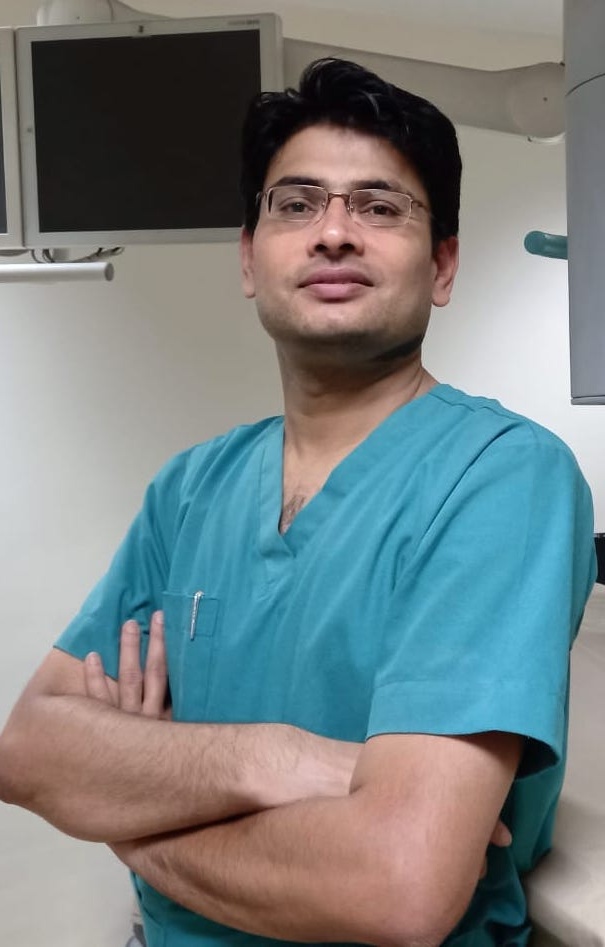
Dr. Bibek Nepal is a Consultant Interventional Radiologist at Kathmandu Cancer Center. He completed his MD in Radiodiagnosis at Tribhuvan University Teaching Hospital (TUTH) and then trained as an Interventional Radiologist at Max Superspeciality Hospital, Saket, New Delhi — one of India's leading centres for interventional radiology. He runs the interventional radiology programme that underpins the entire oncology workflow at KCC.
Interventional radiology sits at the intersection of imaging and treatment. Every needle placed is guided. Every decision is real-time. Dr. Nepal confirms cancers with CT-guided and ultrasound-guided biopsies every working day — making KCC one of the fastest places in Nepal to go from suspected cancer to confirmed diagnosis and treatment. When a patient with liver cancer cannot have surgery, it is Dr. Nepal who ablates the tumour with heat through a needle. When a cancer blocks the bile duct, it is Dr. Nepal who drains it without open surgery.
With over 8 years of experience and 1000+ successful procedures, Dr. Nepal provides the diagnostic and therapeutic procedures that make the rest of cancer care possible. His services include daily biopsy with rapid reporting, liver tumour ablation (RFA/MWA), bile duct drainage (PTBD), ascites and pleural fluid drainage, PICC line insertion, and advanced hepatic procedures — all under imaging guidance, without open surgery.
Needle Precision. No Open Surgery. Rapid Results.
Dr. Nepal's approach is centred on minimally invasive, image-guided procedures that deliver diagnosis and treatment without the need for open surgery. Biopsies are available every day at KCC — CT-guided or ultrasound-guided — with rapid pathology reporting. Results are typically available within 2–3 working days, with FNAC results often the same day.
For liver tumours, ablation (RFA/MWA) destroys the cancer through a needle — no incision, no stitches, and most patients go home the same day. For complications like blocked bile ducts, ascites, or blocked kidneys, guided drainage provides immediate relief. For long-term chemotherapy, PICC lines and tunneled catheters protect arm veins and provide reliable access for the entire treatment course.
"Interventional radiology sits at the intersection of imaging and treatment. Every needle we place is guided. Every decision is real-time. The patient gets a diagnosis — or a treatment — without an operation. That matters enormously when they are already facing cancer."
Areas of Expertise
Medical Qualifications
Professional Memberships
- Nepal Medical Council (NMC)